




What Is Ambient When Everyone Is Making It?

I have just spent three days as a fly on the wall at a conference on ambient music at the Rhythmic Music Conservatory in Copenhagen. Three days packed to the brim with subjects as varied as digital rest stops on TikTok, the AI-ification of ambient playlists, the use of music as both medicine and sex toy, New Age, dub culture in 1980s Czechoslovakia and much, really much, more.
After three days immersed in the intellectual mire of ambient music, I have resurfaced slightly dazed, but with a pile of thoughts about the genre’s past, present and future. Here are five of them.
After three days immersed in the intellectual mire of ambient music, I have resurfaced slightly dazed
1. It’s Time to Leave the Greats Behind
Ambient discourse still seems to have trouble moving very far beyond the genre’s holy trinity of Satie, Cage and Eno. By the end of the first day of the conference, I had lost count of how often they were mentioned, referenced and quoted.
To be fair, they are all talented artists and influential thinkers. But they also have in common the fact that they are old white men. Two of them, in fact, are so old that they died 101 and 34 years ago, respectively. Brian Eno – the only living member of the triad – remains a particularly persistent shadow through his oft- (and over-) quoted maxim that ambient music should be »as ignorable as it is interesting«.
Perhaps it is time for those of us interested in ambient to make an effort to turn this maxim, at least in part, back on its author and the other two greats, and instead turn our attention and our ears towards the many artists who are challenging the genre’s established dogmas. This was precisely one of the aims of the conference: to highlight how different and interesting ambient can be when we move beyond such a narrow and at times exclusionary frame of reference.
2. AI Might Make Ambient More Interesting
As in so many other areas, generative AI is changing the landscape. Because of its particular mode of expression, ambient music is especially vulnerable to this development. If you can generate hours of functional music that is sufficiently pleasant and sufficiently anonymous for sleep, study and meditation playlists, there is not necessarily any economic reason to have a human being make it.
This is an ongoing process, and there is little reason to think it will stop with this already rather generic form of music. It merely underscores the importance of artists who have something genuinely at stake, even within an art form that often actively makes use of anonymity as an aesthetic marker. It may actually turn out to be a blessing in disguise that this technological development forces ambient musicians to distinguish themselves from the authorless mass production of AI slop.
I primarily understand the genre through the body
3. Ambient Is a Genre You Feel
All the fascinating and inspiring discussions about ambient music also reminded me of something more mundane: I primarily understand the genre through the body.
I have always found it difficult to write about ambient, for instance in reviews. My relationship with the music often lies somewhere other than the purely intellectual. This became clear on the third day of the conference, when Joseph Kamara, who works under the name KMRU, delivered the keynote.
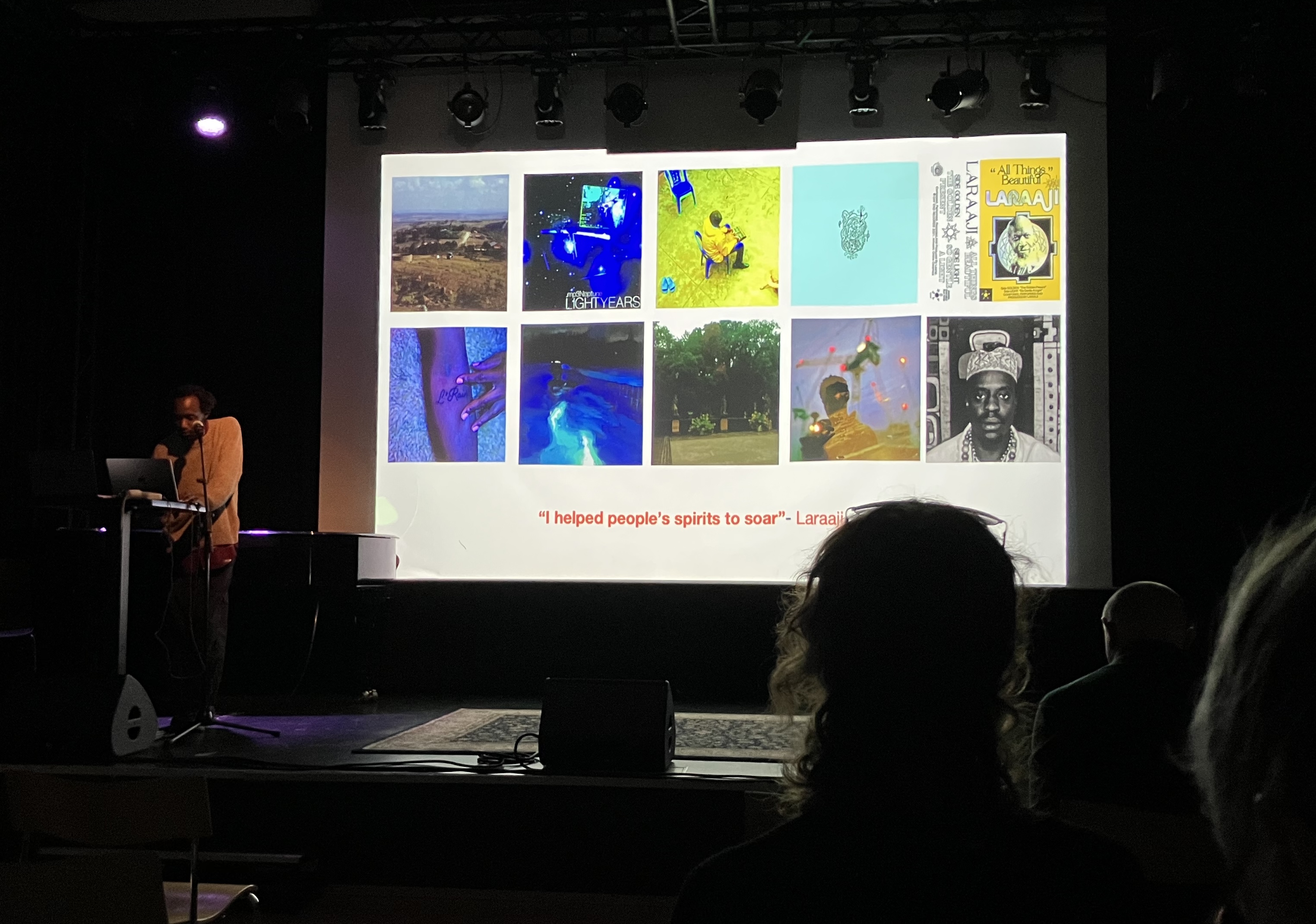
His presentation consisted of a mixtape, sparse quotations and lots of cover images, and became a highly personal account of his own place in the history of ambient music.
It was a moving experience, and it reminded me that – at least for me – it is important to find a healthy balance between the analytical approach of the critic or academic and the more instinctive relationship with how the music actually affects me.
4. Ambient Music as Medicine
Ambient, and particularly its more spiritually inclined younger sibling New Age, has long been associated with all kinds of health applications, many of them of a dubious nature. But perhaps there is something to it after all. Research suggests that certain forms of ambient music do in fact have a measurable anxiety-reducing effect, which could be used alongside conventional treatment and, in some cases, potentially even replace it.
Ambient is a genre that has had to fight to be taken seriously for most of its history
I remain sceptical about how effective this will ultimately prove to be, especially when questions of scale and patients’ individual needs and tastes enter the picture. But it will be an interesting field of research to follow.
5. The Genre Still Has an Identity Crisis
Ambient is a genre that has had to fight to be taken seriously for most of its history. Like so many other genres that challenge our understanding of what music can be, ambient has long had to endure accusations of being »not music«. When New Age really entered the mainstream, well-regarded ambient musicians such as Steve Roach reportedly felt the need to publicly distance themselves from the new genre in order not to be associated with music for hippies and suburban mothers.
Billie Eilish uses ambient in her pop music, anyone can make it in their bedroom, AI spits it out
Today, the identity crisis looks different, almost the opposite. Billie Eilish uses ambient in her pop music, anyone can make it in their bedroom, AI spits it out, and new wave and core genres are constantly hatching on social media. Ambient has become such an integral part of our culture that the discourse around the genre’s identity is no longer primarily about what ambient is not, but about what it also is. Perhaps that is where ambient finds itself now: no longer as a clearly defined genre, but as something that has already seeped into almost everything.
The Ambient Music Conference: Why is everyone listening to ambient music these days? The international conference at the Rhythmic Music Conservatory brought together researchers and musicians from 17 countries to examine ambient as a global cultural phenomenon – from healing and local scenes to streaming culture and contemporary aesthetics. The conference was organised by Ulrik Schmidt (RUC) and Holger Schulze (KU) in collaboration with the Rhythmic Music Conservatory.