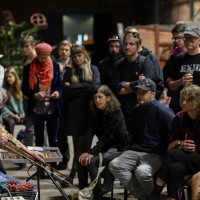
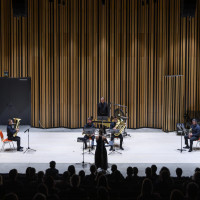
The recently deceased Phill Niblock and Peter Ablinger – both closely tied to Ostrava Days – had new works performed by the Ensemble of Futurist Noise Intoners, on Luigi Russolo’s intonarumori. These wooden crank-boxes, producing everything from deep rumbles to shrill screeches, were originally created as futurism’s rebellion against traditional musical aesthetics.
Tania León’s songs wove a vivid polyrhythmic portrait of Havana into the space
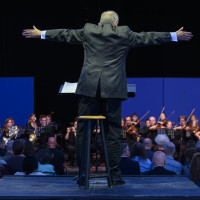
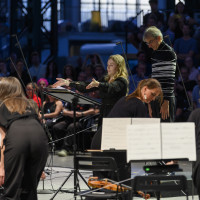
Unlike in previous years, there were only a few American musicians in Ostrava. Ostrava Days has close ties to New York, where festival director Petr Kotík lives. And it was his idea to stage a concert with three orchestras and three conductors on the same stage in four works: Phill Niblock’s Three Orchids (2002–03), Alvin Lucier’s Diamonds (1999), Petr Kotík’s Variations for 3 Orchestras (2003–05), and Bernhard Lang’s GAME XXII (2025). Niblock’s opening in the former industrial hall Trojhalí Karolina was a massive, vibrating sound field: the three orchestras each held to a single tone, but shifted in microtonal intervals so that a stream of overtones, different tones, and resonances emerged. Lucier traced lines of glissandi and overtone play. Kotík made the three orchestras converse in a beautifully chaotic dialogue. Finally, Lang’s unpredictable displacements turned the orchestras into a giant, living loop machine. It was a wild night in every way!
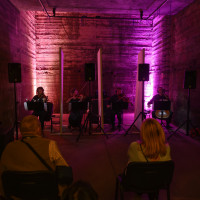
In the Cathedral of the Divine Saviour, Klaus Lang’s cantita christinae IV – past-time (2021) unfolded more austerely, while Tania León’s songs wove a vivid polyrhythmic portrait of Havana into the space.
Afterwards, at Klub Parník, New Yorker Thomas Buckner performed Cornelius Cardew’s Treatise together with music students. This was far better than Roscoe Mitchell’s failed concert some years ago on the same stage. The evening ended with hip hop and Americana – young classical musicians clearly have a broad horizon.
From mists to silence – a panorama of today’s music
Concert after concert, Ostrava Days painted a picture of contemporary music’s breadth. I will never forget how three flugelhorns, three tubas, and percussion created a deep, almost bodily resonance in a work by Petr Cígler. And I will fondly remember how 24-year-old Wei-Shiang Chang made the festival orchestra Ostravská banda whisper like mists through a Taiwanese mountain valley.
While Martin Klusák, in his Lighthouse (2025) piece, let us feel the shifting currents of the sea, Alex Mincek’s work unfolded like a filmic meditation, where rhythmic cells constantly found new constellations – like a mobile in ceaseless motion. And Robert Karpay’s Deep Summer Nocturne (2025) took its point of departure from Bartók’s night music, but ended in drones and melancholy weight with echoes of Radiohead’s Kid A.
One conductor had his hands tied while the piano unfolded in horror-like themes with clear reference to Ligeti
In that concert alone it was clear that contemporary music does not move in one direction but unfolds as a journey through sound’s many possible landscapes. Several young composers worked with simple processes and limited parameters – like Tymon Zgorzelski, who translated his fascination with astronomy into small rhythmic displacements and meetings of timbres.
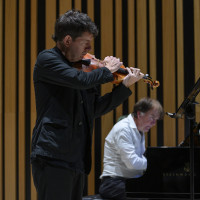
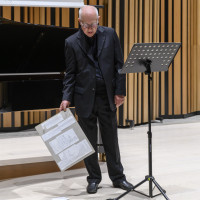
The panorama drawn by the concert with six world premieres showed how composers today think of music: as nature’s fog, as the darkness of memory, as filmic image – and yes, there was no lack of cinematic imagery in Ostrava this year – as rhythmic construction, as democratic conversation, or as strictly structured architecture. Theatrical concepts also had their place: one conductor had his hands tied while the piano unfolded in horror-like themes with clear reference to Ligeti.
In Ostrava one could encounter several young composers worth following. Szymon Golec’s intense journey into layers of the psyche with small roars from four saxophones played by the Canadian quartet Quasar was marvelous. And Pennsylvania-born Matthew Huang Mailman offered a playful piece where his fascination with trains was transformed into rumbling and clattering. It was both sensuous and imaginative, and you could sense the steam in the saxophones. Incidentally, the Canadian saxophonists opened the concert with their compatriot Claude Vivier’s Pulau Dewata (1977) – a fantastical homage to Bali.
For me, the festival culminated in the kitchen of the abandoned Hotel Palace
Dadaist primal force and French drones
Christopher Butterfield knocked everyone off their feet: stiff as an undertaker, he breathed life into Kurt Schwitters’ Dadaist Ursonate (1923–32), which felt astonishingly contemporary in our TikTok era. Together with pianist Daan Vandewalle he also let Satie’s Socrate (1917–18) unfold its cool beauty with rare elegance.
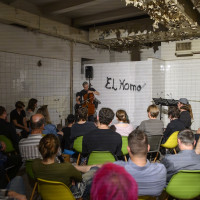
For me, the festival culminated in the kitchen of the abandoned Hotel Palace, where cellist Charles Curtis performed Éliane Radigue’s Naldjorlak. A single long bow stroke over the strings opened like a microscopic universe – a slowly shifting field of overtones and vibrations where the silence around the music became almost as important as the sound itself.
Ostrava, which this year marked its 13th biennale since its beginning in 2001, reaffirmed its role as both laboratory and meeting place – a space where new ideas can be tested, and where even the smallest tone can open new ways of listening.
Ostrava Days, Ostrava, Czechia, August 21–30, 2025
English translation: Andreo Michaelo Mielczarek. Proofreading: Geoff Cox