




Into the Unknown

If you’re not familiar with the music of Žibuoklė Martinaitytė, you should be. Across a series of mesmerizing orchestral and choral works, the Lithuanian composer has advanced the cause of the »new tonality« Schoenberg and his ilk never thought viable while reenergizing the modal longing of the Baltic school. Her music combines stillness and movement, but in a strikingly different manner to that of Arvo Pärt.
If you’re not familiar with the music of Žibuoklė Martinaitytė, you should be
Martinaitytė’s long-sighted forms buzz with their own internal virility. They relish the possibilities of orchestral colour and timbre but don’t restlessly twist the kaleidoscope, instead enacting incremental change with delectable restraint. Her choral music has used similar tools – anchored by pedal notes, enlivened by internal textural fission, often shunning traditional language and embracing indigenous techniques such as Inuit throat singing.
All are in evidence in Upside Down, first seen last week at the Lithuanian National Opera in Vilnius. Martinaitytė’s first opera was never going to be a fast-paced, dialogue-heavy theatre piece. That starting point might have led her to collaborate with Robert Wilson – the experimental writer and director known for masterminding the slow-burn surrealism of Einstein on the Beach. It looked like a good fit: a non-narrative theatre piece in the Meredith Monk/Philip Glass mould, suiting the breadth, depth and patience of Martinaitytė’s deeply-dredged music.
Robert Wilson is far from forgotten in the result
By the time he died in the summer of 2025, Wilson had outlined the general concept and designed the floorplan: a scheme of three acts and three scenes, each of prescribed proportions, containing theatrical episodes in which the Arctic region would form setting, character and aesthetic basis. Martinaitytė and dramaturg Konrad Kuhn completed the libretto begun by Wilson, whose long-time associate Nicolas Panzer stepped in to direct.
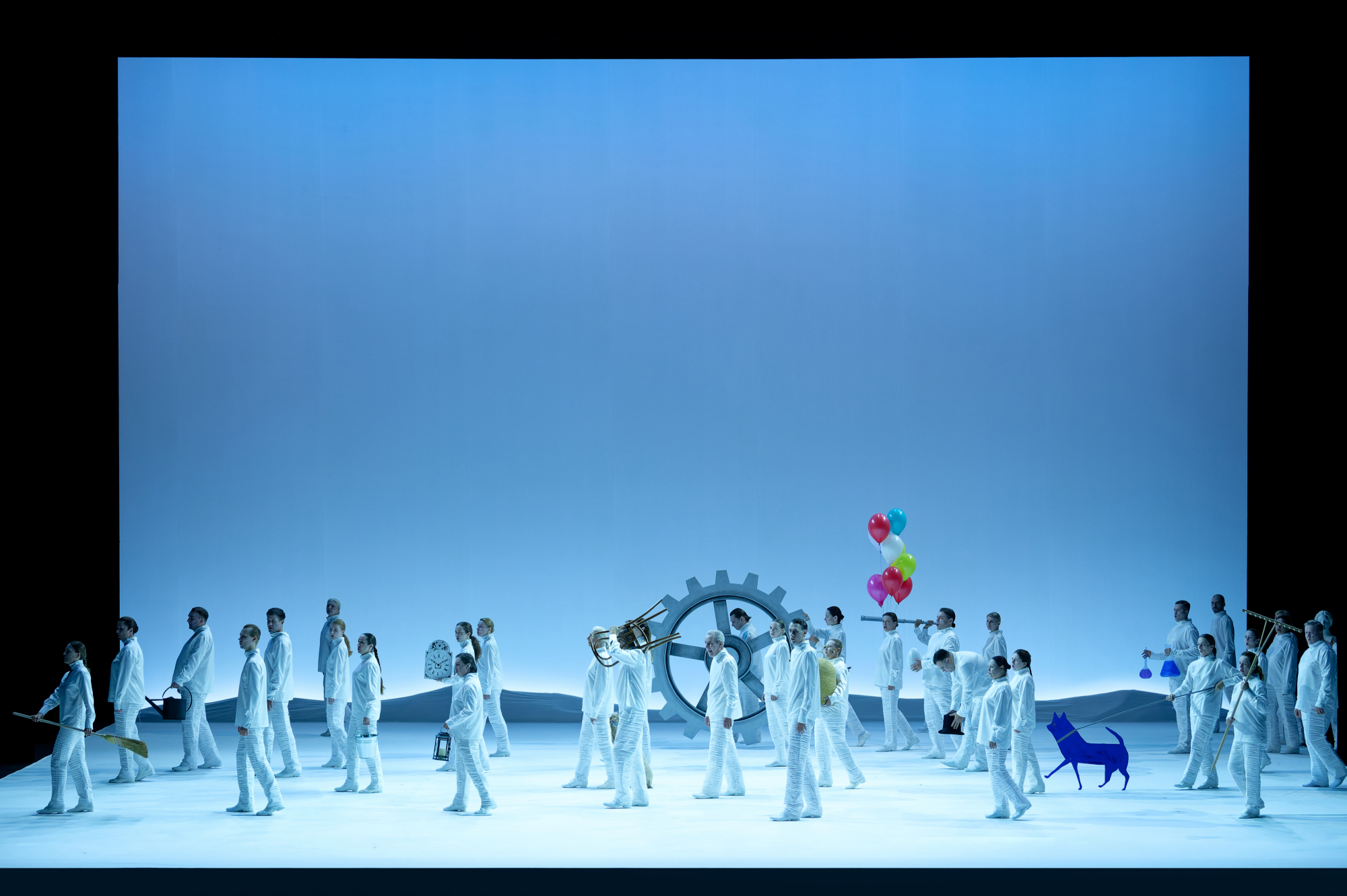
Wilson is far from forgotten in the result. The English title Upside Down is his (in Lithuanian, Apversta Tikrovė translates to something more like »Reversed Reality«) while Panzer’s staging channels the spirit of her former colleague in its pace, loose symmetry and stark lighting (Marcello Lumaca).
Music of Ice and Light
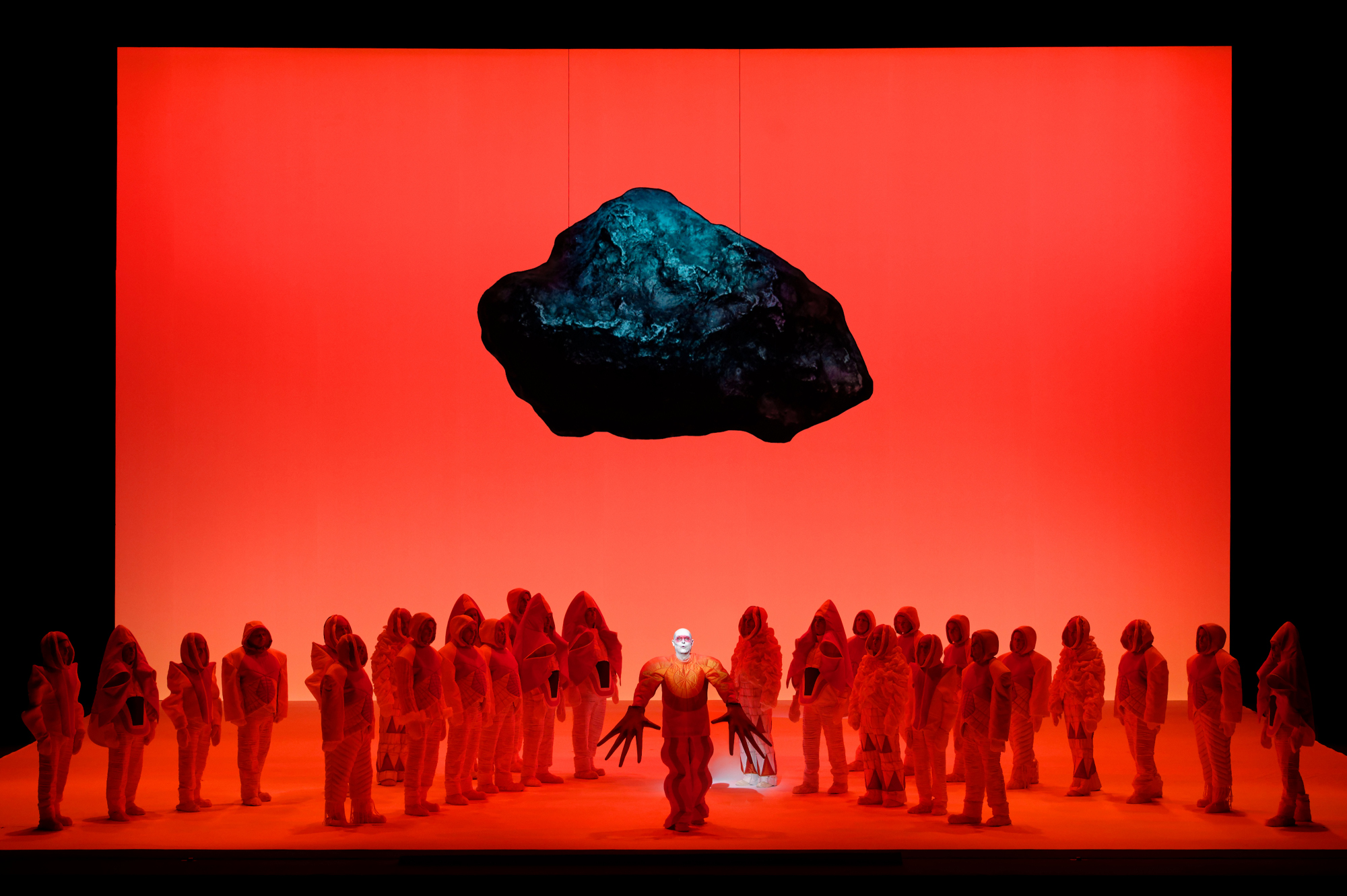
What we see on stage never strays from the natural impetus of Martinaitytė’s music, whose vast expanses and glacial depths form a potent sonic counterpoint not just to the images of the Arctic we see, but to the whole concept of striking out into the unknown and the vast feelings that process can induce. The composer has spoken about the colour blue embodying an atmosphere of »the unattainable and the unknowable«. Here we get to see as well as hear what she means. In its visual starkness and sensitivity to colour, the production has something of the atmosphere of a staging by Hotel Pro Forma.
Powering all this is an extraordinarily resourceful score, skillfully dispatched by the forces of the Lithuanian National Opera under Robertas Šervenikas (who shares the conducting with Modestas Pitrėnas, credited as the show’s Music Director). The work opens with a cleansing Prelude for chorus and orchestra, deep-rooted, fizzing with instrumental activity that transfixes the ear without ever moving from its fundamental position and sound – not just neo-tonality, neo-minimalism too.
From there the score unfurls, each section apparently born from the same roots but always reaching far out in different directions. Much of it is based on diatonic intervals or the modality familiar from Baltic music of old. Added to that is Martinaitytė’s extraordinary ear for timbre (percussion as twisting metal and cracking ice), her mesmerizing way with the overtone spectrum, judicious use of accordion and organ and her ability to hoard-up colossal latent power in an orchestra weaving different paces and rhythms. When the protagonist Traveler dons a warm coat upon arrival in the Arctic, she is momentarily warmed by hugging brass chords.
Sometimes they whistle, at others they employ gestures that sound like Inuit throat singing
Towards the end of the work, an immense, radiating crescendo is set in train before giving way to a delicate, crystalline coda. Earlier on, the chorus is layered through the theatre’s own acoustic as it processes across the stage and then behind it out of vision, like a great tide of humanity, the invisible singing reverberating against that in the foreground. Chorus and soloists sing in English, Lithuanian, Inuktitut and in no language at all. Sometimes they whistle, at others they employ gestures that sound like Inuit throat singing – an extension of techniques heard in the composer’s own Uululations and Aletheia.
A Dream Without a Story
Martinaitytė refers to her music in general as »a progression of states«. At its most fundamental, that might be what Upside Down is. Pre-publicity was careful to warn us that there was no through-narrative in the piece, whose nine scenes resembles phases of a dream more than the chapters of a story. It’s a classic piece of post-modernism in the sense that the audience interprets not just meaning but action.
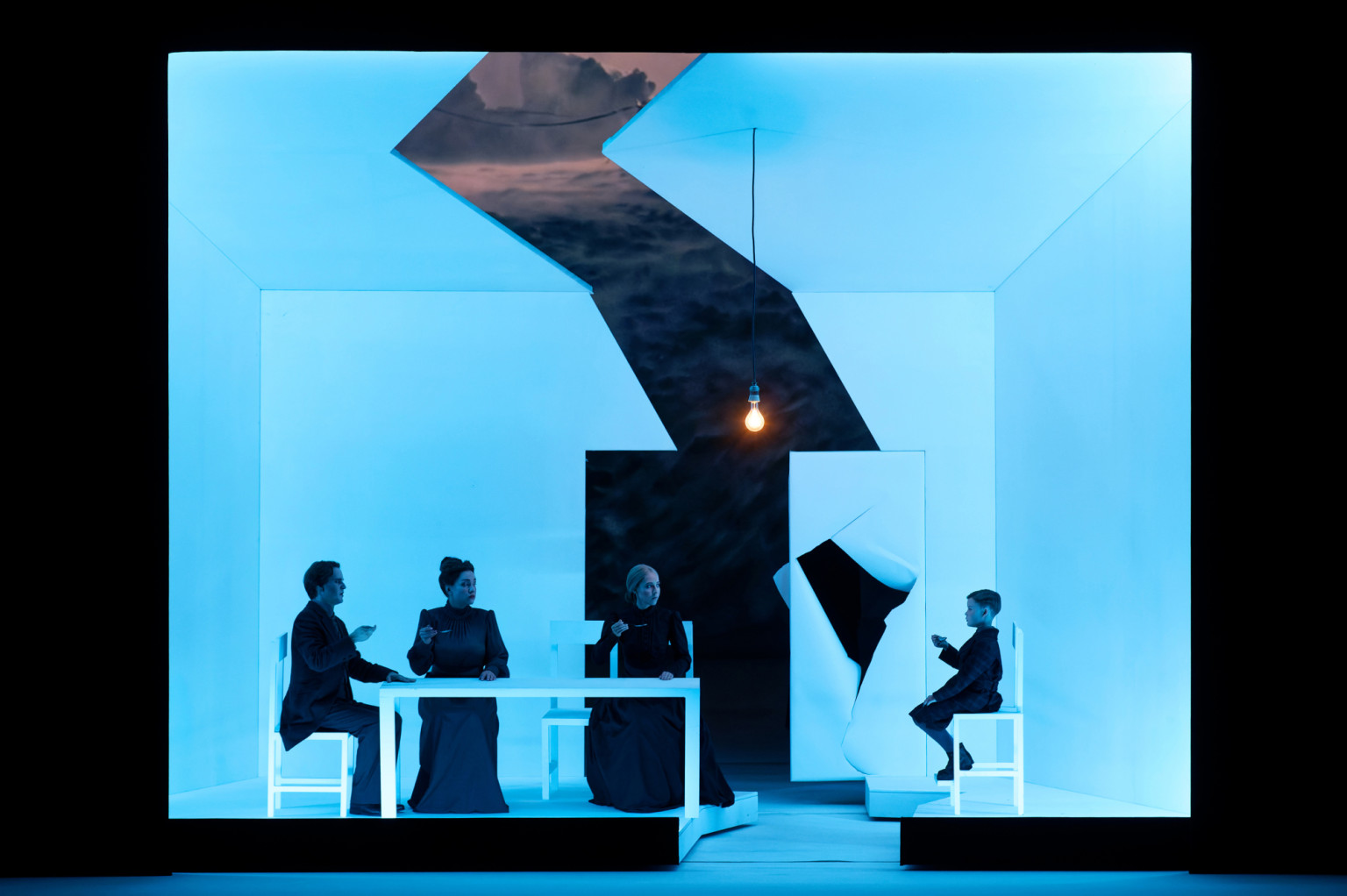
But there’s a pretty unequivocal message in the work too given the repeating idea of leaving the comfort of a »home« for the disorientation and discomfort of an alien territory. Each act begins in the same dwelling before heading out into the Arctic wilds; the suggestion is that comfort only exists in the context of its opposite. You can’t accuse Wilson and Panzer of obfuscation in the staging: the gestural language is clear and if there is surrealism, it’s pre-prepared (a person appears with dogs for feet, but only after a boy has expressed longing for a dog). There is more clarity here than much of what you’d see at Copenhagen Opera Festival.
Each act begins in the same dwelling before heading out into the Arctic wilds
That has as much to do with the strength of the score as the production, or the fact that each bears an umbilical relationship to the other. If opera is an art form defined by its embracing of many media, Upside Down extends its reach – not only in a score that combines focus with breadth, but also in a staging that uses varied methods of storytelling from ancient to modern, from ritual dance to AI (including one rather naff video sequence). Opera also needs to set the pulse racing and Martinaitytė’s music does that in Upside Down, even before the curtain rises.
Žibuoklė Martinaitytė: »Apversta Tikrovė« (»Upside Down«). Lithuanian National Opera and Ballet, 24 September 2026. Until 30 May 2027