



The Royal Danish Opera Has Its Finances in Order – Now It Must Invest in the Future
There is a changing of the guard at the top of Danish opera. Kasper Holten, director of the Royal Danish Theatre, has announced his departure, while opera director Elisabeth Linton, whom Holten helped appoint in 2022, has had her contract extended by four years. What should we make of these striking announcements? Holten’s departure signals change, while Linton’s extension points in the opposite direction: continuity.
When Holten took over in 2018, the theatre was under severe financial pressure. His strategy was clear: sell tickets. The Royal Danish Theatre had to abandon its highbrow sensibilities, become more family-friendly and court the musical theatre audience with a broader repertoire.
His strategy was clear: sell tickets
The strategy worked, and Holten leaves the theatre’s finances in good shape. Artistically, however, the balance sheet looks rather different. The opera house – or the “procurement centre”, as Weekendavisen music critic Sune Anderberg polemically calls the national opera in his critique – has not managed to programme a single new Danish work in the season that has just begun. Instead, the number of premieres has been almost halved, and the programme cobbled together from numerous revivals and international co-productions. Judging by this season alone, one might think Danish opera was in a coma and that the Royal Danish Theatre was doing little more than keeping it on life support.
Now is the time to future-proof Danish opera
Fortunately, the Danish opera scene is not confined by the walls of the Royal Danish Theatre. Just beyond them, creative ambition is sparking, the pool of talent is growing and passionate advocates are flocking to the field. Consider Copenhagen Opera Festival, where new works take pride of place, or the smaller companies Motherboard and OPE-N, which have made a speciality of staging opera in the most unlikely places. Then look to the regional opera companies Operaen i Midten and Den Fynske Opera, where the development of new works occupies a remarkably prominent place in their repertoires.
It is time for the Royal Danish Theatre to take greater responsibility for developing new opera and launch a targeted initiative of the kind seen at other European national opera houses. Now is the time to future-proof Danish opera.
The value of Danish opera
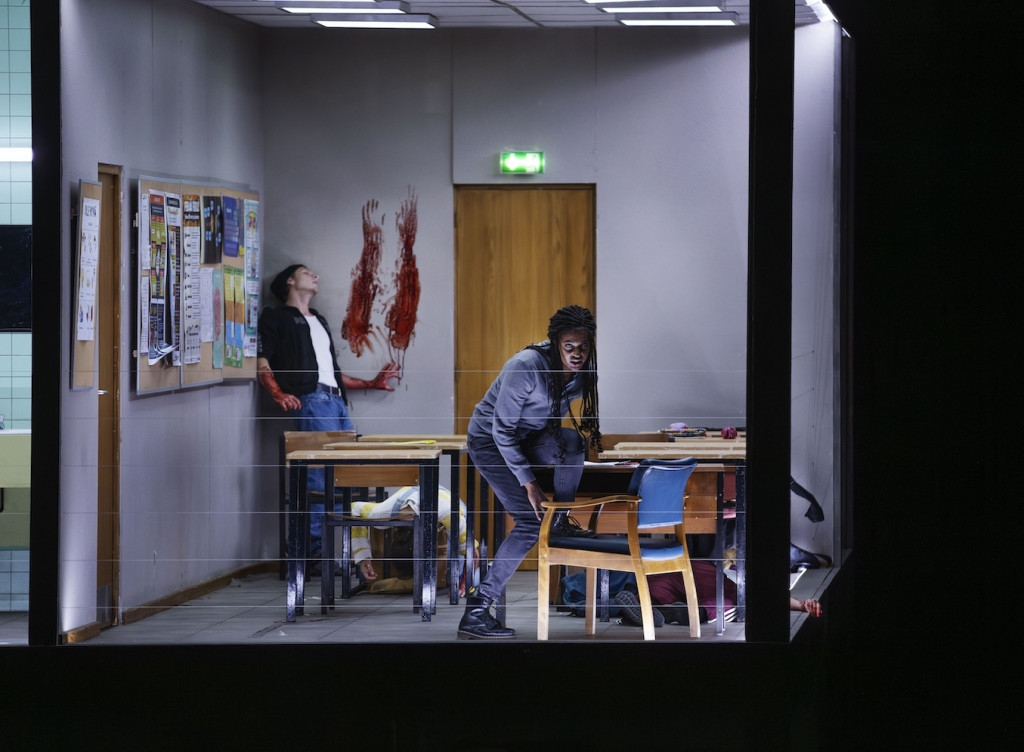
Let me be clear: I have no intention of portraying the Royal Danish Theatre as an entrenched enemy of everything modern. When an opera house with high running costs has to navigate sweeping budget cuts, it is understandable that the biggest risks are the first to go. And the danger of rows of empty seats is, of course, all too real when an unfamiliar title appears on the programme. It is therefore understandable that the theatre would rather enter into major international collaborations and engage the world’s leading composers than take a chance on untested Danish names. This is the case with Kaija Saariaho’s Innocence, currently on stage.
For the same reason, when the theatre does dare to commission a new Danish opera on a grand scale, it is hardly surprising that it turns to established composers such as Louise Alenius, Simon Steen-Andersen and Bent Sørensen.
More troubling is the fact that Takkelloftet, the opera house’s smaller chamber stage, has simultaneously become far less active as an incubator for new opera. Under Linton, Takkelloftet has hosted just one world premiere: Matias Vestergård’s Lisbon Floor – and even that was commissioned and produced by Copenhagen Opera Festival. During the same period, however, the space has been used for the conference Her Perspective: The Forgotten History of Opera, which turned the spotlight on women composers in opera history. Better to rediscover opera’s past than to create its future, apparently.
»The same ten popular titles keep recurring everywhere – including on my own stage«
Linton is not lacking in self-awareness. In the performing arts magazine ISCENE, she questions her own approach to programming: »The same ten popular titles keep recurring everywhere – including on my own stage – and it is an understandable but dangerous path to take.« Yet she could take inspiration from the forceful approach of Anne Barslev, who kicked open the door when she became director of Den Jyske Opera in 2024. The ensuing online backlash was entirely predictable when she introduced a rule stipulating that the company would perform classics only in Danish translation.
The initiative met with such fierce criticism that Barslev’s courage in giving the company a clear identity was almost overlooked. But the idea is not so misguided after all: a translation can open up familiar classics in new ways and give audiences more direct access to the work, since their eyes no longer have to keep darting towards the surtitles. All the more regrettable, then, that the idea was not taken to its logical conclusion. Why not insist on the value of opera in Danish by also commissioning new works in the language? That would have been visionary.
But who will compose the grand operas of the future?
The rest of Europe is pulling ahead
Now that the Royal Danish Theatre’s finances appear to have been restored, it no longer seems unreasonable to expect a greater commitment to developing new Danish opera. One might argue, as Holten does, that the national stage, with its substantial public funding, should focus on large-scale productions capable of reaching a broad audience, leaving more niche performing arts to others. But who will compose the grand operas of the future? And if the country’s most heavily publicly funded stage is unwilling to take the risk of nurturing new compositional talent, who will?
With her contract extension, Linton has an opportunity to make a tangible mark on Danish opera. In that respect, the change of leadership above her may prove timely. One can only hope that the next director of the Royal Danish Theatre will not simply continue Holten’s approach but treat it as a springboard for new initiatives in opera. There are already plenty of international examples to draw inspiration from. Consider Dutch National Opera, which has presented new works every year since 2016 at Opera Forward Festival, or The Sugar Factory, a three-year programme launched by Finnish National Opera in 2025 to develop new opera.
Apparently, one has to go abroad to experience the opera composers of tomorrow on a major stage
Another model can be found in Berlin. Deutsche Oper Berlin has just launched Unlimited, a permanent department dedicated to experimental music theatre alongside its traditional operatic repertoire. For its inaugural season, the German company has invited Icelandic composer Bára Gísladóttir to be composer-in-residence and commissioned a new opera, due to premiere in early 2027. This should give us pause for thought: a generational talent such as Gísladóttir, who is otherwise closely associated with the Danish composition scene, will present her first full-length opera in Berlin rather than Copenhagen. Apparently, one has to go abroad to experience the opera composers of tomorrow on a major stage.
New opera need not be a loss-making venture at all
The model Holten has created must not be allowed to stagnate. It would be disastrous if Rindalism took root at the Royal Danish Theatre and the institution began to measure its legitimacy primarily in terms of broad appeal and ticket sales. Now that its finances are back on track, the time has come to invest in the next generation of opera. New opera need not be a loss-making venture at all. The Metropolitan Opera, for instance, has succeeded in making contemporary opera a box-office draw by marketing it as accessible, narrative-driven music drama rather than navel-gazing avant-garde. Interest in last year’s commissioned work, Mason Bates’s cinematic The Amazing Adventures of Kavalier & Clay, was so strong that the theatre had to add four extra performances to the schedule. Sometimes, taking a risk pays off.
English translation: Andreo Michaelo Mielczarek