






Langgaard Lets His Hair Down
Rued Langgaard would probably have had no objection to his music being performed in Ribe. But perhaps he would have wanted it to escape the churches.
For although the Rued Langgaard Festival year after year unfolds new facets of the composer’s strange and somewhat long-haired universe, the city around it is conspicuously little involved. This year, two churches and an old, closed rural savings bank served as the primary venues. In return, the festival allowed Langgaard to encounter Sweden, visual art and new interpretations of his music.
Rued Langgaard would probably have had no objection to his music being performed in Ribe
This produced some of the festival’s strongest moments. But also a recurring question: how do you get a composer who, in his own time, stood slightly apart from everything to truly inhabit the city that has made him its own?
A Room Can Be a Mess
At Sct. Catharinæ Church, the first evening concert, Dora and Rued’s Symphony, demonstrated both how much a space can give and how much it can take away.
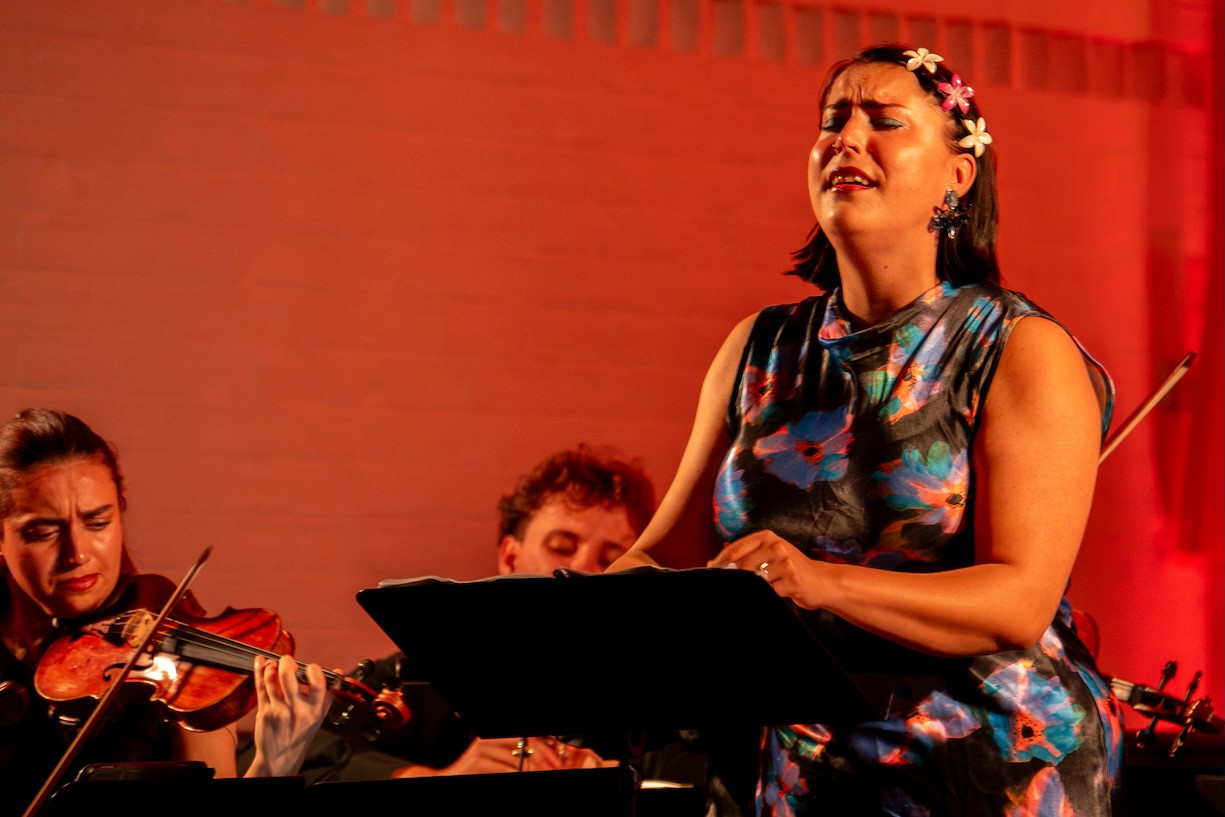
The work is a theatrical reworking of Langgaard’s songs and his youthful love for Dora From. Josefine Weber Hansen on viola and vocals opened with Langgaard’s Dora theme. First on viola, then singing, and finally doing both at once. She was the concert’s highlight: probing and deeply present with both voice and strings.
Here, the church worked with her. It was different with Lotte Andersen. She was engaging and involving as Dora, but Sct. Catharinæ worked against her. Her amplified speaking voice ricocheted between the walls, causing the words to lose their contours.
The Berlin Philharmonic had already seen what the long-haired teenager was capable of
Something similar happened during a performance of Langgaard’s Second Symphony with an expanded Esbjerg Ensemble. The ensemble rarely disappoints and, in the church, sounded almost like a full symphony orchestra. The powerful voice of soprano Laura Helene Hansen, on the other hand, was whipped around the space, occasionally pushing her into overdrive.
Lene Juhl’s visual staging was more restrained. Sensibly so. When a space is already doing so much to the sound, the lighting does not need to do the same.
The Long-Haired Teenager
Friday’s concert took Langgaard out of the small, intimate narrative and into the large format. Lene Juhl had brought in material from Kullen, the Swedish rocky landscape that is said to have inspired the fourteen-year-old Langgaard when he began his first symphony, Klippepastoraler (Rock Pastorals).
In Denmark, the work was not welcomed at the time. Germany, on the other hand, embraced it. The Berlin Philharmonic premiered the symphony in 1913 and had already seen what the long-haired teenager was capable of.
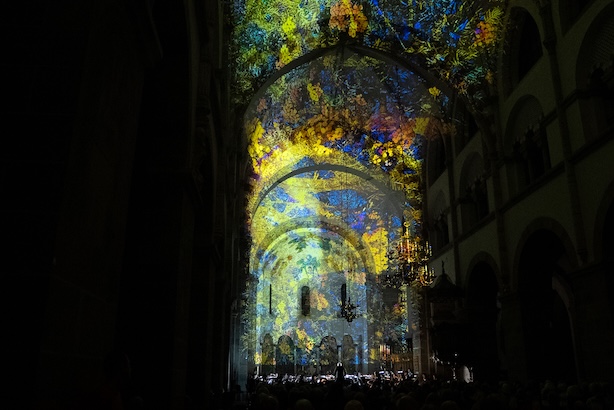
So did the audience in Ribe Cathedral on Friday evening. From the very first bars, Klippepastoraler struck with an intensity that almost physically filled the cathedral. The expanded South Jutland Symphony Orchestra had brought in twenty students to complete the ensemble, with Thomas Dausgaard on the podium.
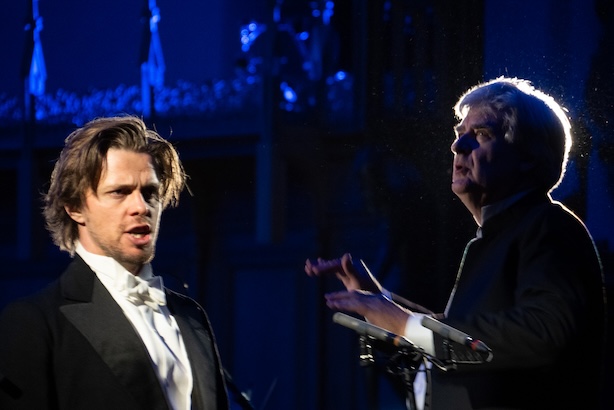
The winds faltered in places during the second and third movements. In return, Lene Juhl’s canopy of light moved across the orchestra, the altar and Carl-Henning Pedersen’s frescoes, so that the audience almost had to tilt its head back to follow it.
Did light and sound work together? Yes and no. The trans-aesthetic dimension of classical music is divisive. Critics can reasonably ask whether visual art steals attention from the orchestra. That happened in Ribe Cathedral, too.
But does it matter? Not really. Juhl does not use the visual art as decoration. She makes the entire church space move. Even Carl-Henning Pedersen’s frescoes began to resemble dancing rock demons to the sound of the young Langgaard.
»Why doesn’t Sweden have a composer to match Grieg, Sibelius and Nielsen?«
Langgaard at the Friday Bar
There was a completely different kind of trans-aesthetics at the old rural bank, where the festival’s Café Rued had taken up residence.
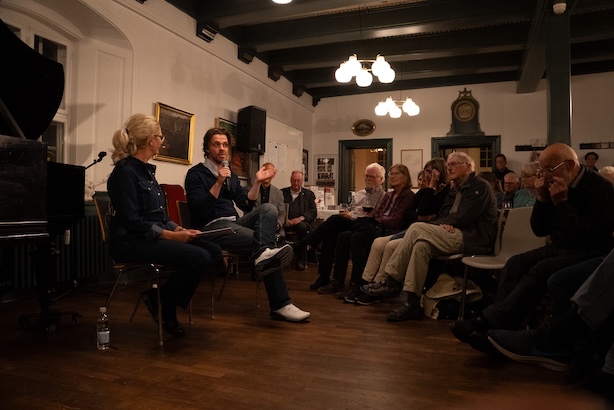
You could buy a Langgaard Porter in the basement and take it upstairs, where the festival’s communications manager, Karen Bendix, spoke with Swedish baritone David Risberg after Friday’s concert.
Suddenly, there was a Friday bar.
During an exchange of jokes about Danishness and Swedishness, Risberg asked:
»Why doesn’t Sweden have a composer to match Grieg, Sibelius and Nielsen?«
»Or Langgaard!« someone shouted from the audience.
Everyone laughed and took a sip of the local porter.
Langgaard does not always have to be presented as the great, serious Danish eccentric
The festival actually had a qualified answer in the form of not one but two Swedish composers with whom Langgaard could be compared: Ture Rangström and Elfrida Andrée. Karen Bendix suggested ABBA. That may be an answer, too. Langgaard does not always have to be presented as the great, serious Danish eccentric. He can also be a composer people gather around a beer to talk about.
Make Him Your Own
One of the most interesting things about an artist’s legacy is the moment when others begin to make the work their own. That was exactly what the winners of the 2026 Langgaard Competition did. Nichlas Overgaard has systematically gone through Langgaard’s songs to find those suited to the guitar, and rearranged them. It is a piece of pioneering work.
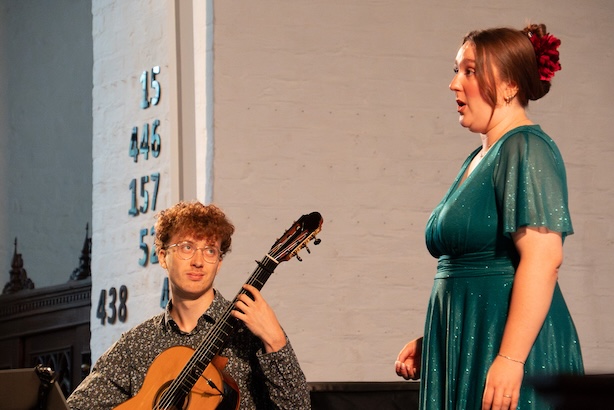
If you want to spread Langgaard’s music, it is difficult to imagine a more concrete way of doing so than allowing it to change instrument and context.
In Sct. Catharinæ Church, however, the balance between guitar and voice was not always equally successful. Siri Sofia Jakobsen’s lyrical soprano occasionally slipped away, while the guitar remained, even though it was amplified. Once again, the space revealed itself as an active collaborator – and adversary. I could not help wondering what the duo would have sounded like in a smaller room. Ribe Art Museum, perhaps. The old town hall. Somewhere the guitar could be allowed to be a guitar and the voice a voice.
The Swedes Are Coming
Under the programme heading Hélsingeborg, the Helsingborg Symphony Orchestra performed Langgaard’s Tenth and Twelfth Symphonies in Ribe Cathedral.
The Twelfth is the older Langgaard’s recomposition of the First, Klippepastoraler. Here, the music has been compressed, ultra-short and ultra-energetic. Towards the end, Langgaard has written: »Amok! A composer explodes.«
Fortunately, there was no explosion in the cathedral. But the reverberation stood sharply defined in the space, and the Swedish winds did not face the same difficulties as the South Jutland players had the previous evening.
After the concert, it was back to the old rural bank. This time, there was a party
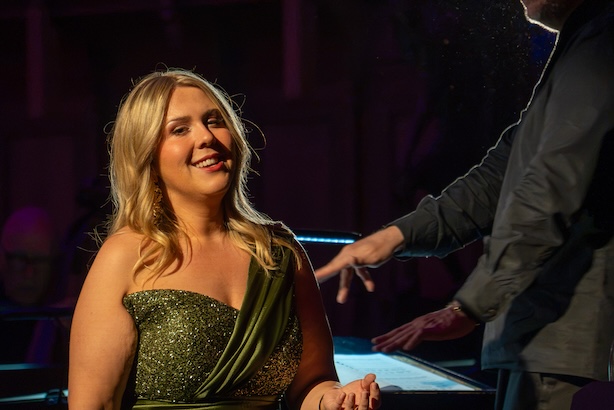
Tobias Ringborg conducted an excellent concert. So did Christina Nilsson. During rehearsals, the Swedish soprano had asked the festival to work with something that had belonged to Langgaard. Ribe Cathedral organist Birgitte Ebert therefore retrieved an old music stand from behind the cathedral organ, allegedly belonging to her predecessor.
It now stood in front of Nilsson as she sang songs by the Swedish Elfrida Andrée – including Förlåt mig from the opera Fritjofs saga – with texts by Selma Lagerlöf and Bo Bergman.
As a proud Scanian, Christina Nilsson carried both the name and the region with her. It was difficult not to be swept along.
After the concert, it was back to the old rural bank. This time, there was a party. In addition to the two buses carrying musicians, two buses carrying Swedish music fans had arrived. The room was packed, everyone had a drink in hand, and an orchestra manager later reported on Messenger that it was well past midnight before the last guest went home. Perhaps this was where the festival most convincingly became part of Ribe.
Weave Langgaard Further
On the final day of the festival, I said goodbye to my host. When asked whether he, too, was part of the festival, he hesitated.
»Ah … it’s a bit long-haired.«
I found myself thinking about how much we want to make room for the obscure, the long-haired, the strange snails – everything we see in Langgaard and recognise something of ourselves in.
When Bendt Viinholt Nielsen explained in his lecture that Langgaard also drew and painted, another story about the composer suddenly opened up. Not only one about his relationship with Sweden, but about the connection between sound and image, between music and space. Langgaard was not merely a composer, but also a talented visual artist with a sure hand when it came to pencil and brush.
The trans-aesthetic is like long hair: it can be braided in many directions
The trans-aesthetic could therefore usefully play a larger role in the festival, particularly as the national theme continues next year and Sweden gives way to France. Here, tradition can meet renewal, and Langgaard can be allowed to move between the arts.
Because the trans-aesthetic is like long hair: it can be braided in many directions. But perhaps the most important braid is the one that takes Langgaard further out into Ribe. Out of the churches. Into the museum, the town hall, the café, the streets. Langgaard was never entirely easy to place. He does not need to become so now.
Rued Langgaard Festival, Ribe, 2–5 September 2026
English translation: Andreo Michaelo Mielczarek