


From Coal Dust to Sound Art
Coal, steel, and heavy industry created the Ruhr region. Much of Western Europe’s prosperity was built here, where the ground was filled with coal – the most important energy source of its time. But coal-burning belongs to the past, and in recent years North Rhine-Westphalia has attempted to forge a new identity through culture.
Much of Western Europe’s prosperity was built here, where the ground was filled with coal
The state invests heavily in art and music: symphony orchestras, museums, theatres, and festivals. In particular, it seeks to attract international attention through new cultural initiatives and extensive programmes for foreign cultural journalists. Two of the most significant ventures are Orbit in Cologne – a festival for experimental music theatre – and Wittener Tage für neue Kammermusik in the provincial town of Witten northeast of Cologne.
Witten has only around 100,000 inhabitants, yet contains several music venues and an impressive concert hall with room for roughly a thousand people. Scattered throughout the city, the enormous industrial buildings of the coal era still stand as monuments to a vanished age. It almost felt like an apt metaphor for the festival itself: searching for small veins of gold in piles of dark material.
The long seriousness
There was a great deal of music in Witten. And much of it was heavy, serious, and far too long.
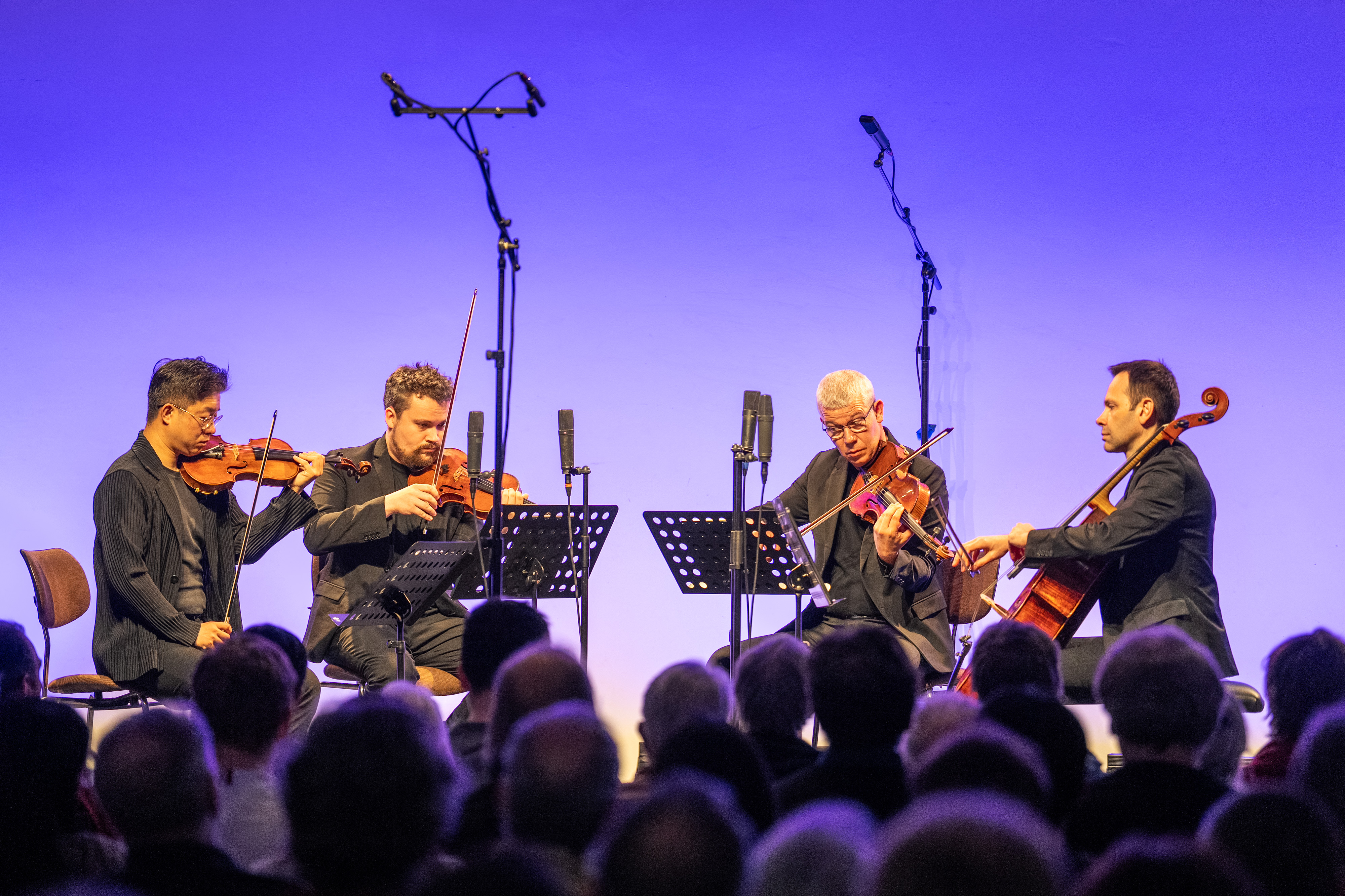
The festival’s featured composer was Chaya Czernowin, professor at Harvard University and a major figure in international contemporary music. Several of her works were performed during the festival, all marked by the same dark, inward-looking tone.
In Earth: Alchimia Communicationis, performed by Klangforum Wien, ominous alarm signals emerged between the winds and deep sonic textures. The bass clarinet was manipulated with cloth inserted into the bell to create even darker resonance, while the double bass moved between live performance and looped recordings. The result was a bleak and almost catastrophic sonic landscape that at times recalled the dark universe of Bára Gísladóttir – though without quite the same precision and depth.
Czernowin’s works certainly possessed force and consistency, but also an almost demonstrative distance from the audience. The same seriousness permeated much of the festival. The programme book, more than eighty densely written pages long, explained the works in a kind of art-theoretical language that often revealed less about the music than about the composers’ self-image. One typical formulation described how »the ensemble merges in shared resonance« and becomes »one collective body«. Beautifully phrased perhaps, but also strikingly lacking in concreteness.
The problem was not complexity in itself, but that many works seemed trapped in a closed circuit between composer, ensemble, and programme note. The audience was often reduced to witnessing processes that appeared more important to the creators than to the act of listening itself.
Several works suffered from the same problem: a lack of formal discipline
The curse of the thirty-minute piece
Several works suffered from the same problem: a lack of formal discipline.
Alberto Posadas’ Kintsukuroi for piano, saxophone, and percussion contained interesting textures and fragmented sound surfaces, but never truly developed. The material was stretched across roughly half an hour without any clear dramatic necessity. The same applied to Günter Steinke’s Voltage, where electronics constantly sent the music back into the same circuits. The fascination with loops simply overtook the work’s momentum.
Gradually a clear pattern emerged: many composers seemed to work from the assumption that duration in itself creates meaning. But when a work’s central idea is already apparent after eight or ten minutes, the remainder easily becomes an exhausting demonstration of material rather than genuine development.
This became especially evident in Dmitri Kourliandski’s Partially Restored Landscapes for string quartet – perhaps the festival’s least successful work. Hardly any actual tones could be heard; instead there was scraping, knocking, creaking, and dry noise from the instruments’ wood and strings. The musicians performed according to one hundred coded messages inspired by radio-frequency techniques, translated into sound.
What was strange, however, was that many works actually began promisingly
The idea may have seemed interesting on paper, but to the audience the work appeared as half an hour of unfocused noise without direction or drama. The composer himself described the coded names and signals as potential »keys to saving the world«, but in the hall it felt more like an example of the emperor’s new clothes: a closed system to which only the creator himself possessed the key.
The issue was not experimentation as such. New music must necessarily challenge our ideas of sound, form, and structure. The problem arose when experimentation itself became confused with quality, and when all forms of self-criticism seemed to disappear in the process.
What was strange, however, was that many works actually began promisingly.
Johannes Kalitzke’s Tunnel Blue for solo piano, for instance, opened with a fascinating meeting between jazz, atonality, and clear references to Dmitri Shostakovich’s Preludes and Fugues. At several points, almost Keith Jarrett-like improvisatory passages emerged with great freedom and energy. But here too the piece gradually lost focus as it extended beyond twenty minutes.
One could not help wondering whether the festival’s many half-hour works might also be linked to fee structures and commissioning practices. Several international journalists mentioned rumours that the length of works increasingly influences composers’ payment. Whether true or not is difficult to say, but the result was unmistakable: far too much music sounded as though it lacked an editor.
Fortunately, there were also genuine discoveries.
History returns
One of the festival’s most convincing works was Sonja Mutić’s Unvoiced for wind quintet and live electronics. With simple means she created a refined resonant space between the winds and diffuse vocal sounds that gradually emerged like hidden voices within the music.
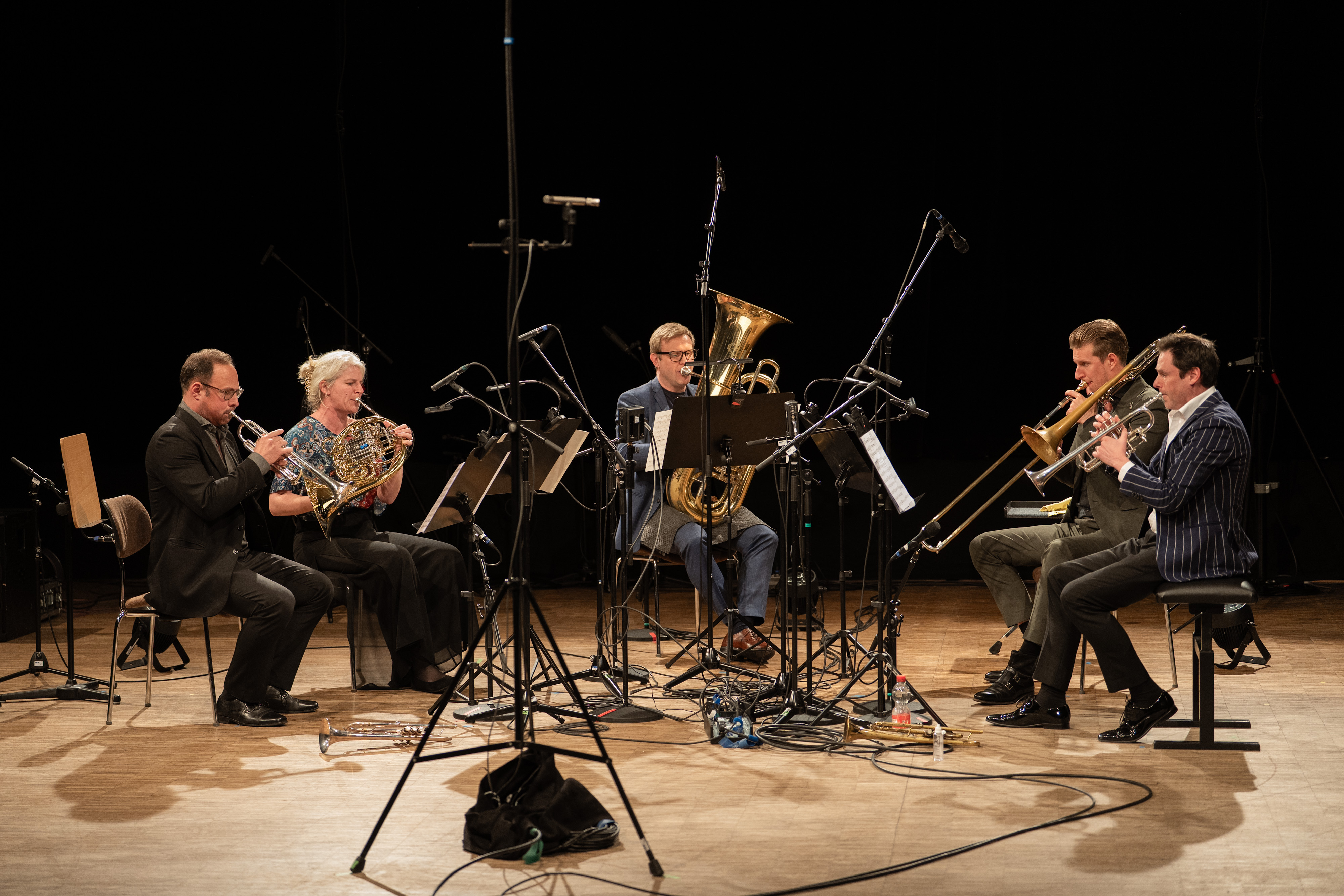
The piece possessed structure, dramatic momentum, and sonic imagination – and lasted only eleven minutes. It said more than many of the festival’s substantially longer works.
One of the clearest highlights was the concert by Basel Sinfonietta, which has also impressed at Danish festivals in the past. The ensemble specialises in contemporary music and possesses a rare ability to choose works with both artistic ambition and musical impact.
At times one could almost hear a Persian version of Max Richter in the repetitive string movements
Iranian composer Golfam Khayam’s Seven Valleys of Love unfolded as a sensitive, almost cinematic love journey filled with Middle Eastern colours and a surprising tonal openness. At times one could almost hear a Persian version of Max Richter in the repetitive string movements and slowly shifting harmonies.
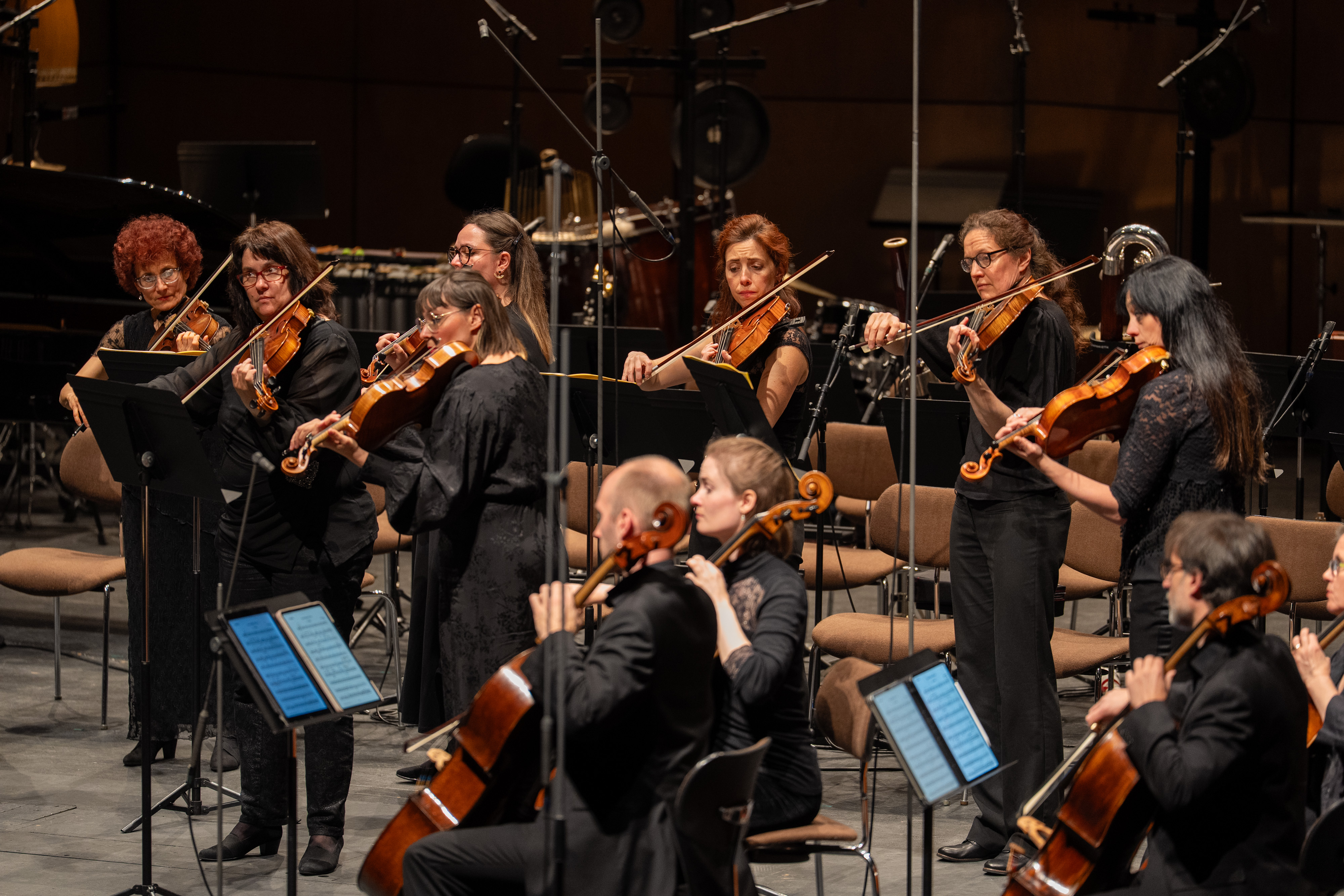
Amen Feizabadi’s Untamed River also worked convincingly with dark vocal sonorities and Middle Eastern-inspired melodic figures. But the most original work was Yair Klartag’s The unconscious structured like a language.
Here, AI-generated voices functioned as a constantly murmuring backdrop throughout the piece. The voices did not form actual words or sentences, but rather resembled the way children experience adults speaking a foreign language: an incomprehensible yet intensely present sonic phenomenon. Above this mass of voices, the orchestra moved like a musical embodiment of inner psychic space.
The work referred to Jacques Lacan’s psychoanalysis and questions surrounding artificial intelligence and the unconscious. But what mattered was that the music actually worked – even without fully understanding all the philosophical layers in the programme note. Here there was humour, structure, and dramatic precision. And again: the piece lasted only around seventeen minutes.
Another work that stood out significantly was British composer Christian Mason’s fourth string quartet, Towards a not yet remembered past…. While many other composers seemed intent on severing themselves from history, Mason actively engaged with music from the fourteenth and fifteenth centuries. Fragments of Solage, Guillaume de Machaut, and Baude Cordier were woven into his own modern musical language in a way that felt both organic and surprising.
The quartet possessed a rare sense of historical depth. The medieval melodies did not appear as quotations or ironic references, but as living material transformed and continued within a new musical language. Several movements possessed an almost hypnotic beauty, and although the work lasted around thirty-five minutes, it never felt excessive. Here there was genuine formal awareness and variation.
The medieval melodies did not appear as quotations or ironic references, but as living material
Sound in the industrial ruins
At the same time as Wittener Tage, the Orbit festival took place in Cologne with a focus on experimental music theatre. The festival is still relatively young, yet already feels like an important supplement to the region’s cultural landscape. Orbit approaches experimentation with a playful and physical sensibility. The most convincing productions were precisely those willing to move away from the concert format and into performative and spatial experiences.
One of the festival’s strongest experiences took place in a disused industrial mill, where the multimedia artist Rochus Aust had created a form of total theatre around the possible collapse of civilisation. The audience moved through the enormous building and actively participated in the performance by throwing wooden blocks down a gigantic chute that had once transported grain through the factory.
The sound of the wooden blocks crashing through the building’s many floors was almost more powerful than the performance’s narrative layers. Together with plastic grenades eventually hurled from great heights onto a gigantic drum, it created a violent and fascinating sonic environment somewhere between installation art, performance art, and music theatre.
Several productions still carried an elitist and closed-off character
Ensemble uBu also impressed with Mutants in Music: Dreamteam, which explored the idea of collective dreaming through a shared playlist. Fragments of György Ligeti, Franz Schubert, Karlheinz Stockhausen, and Else Marie Pade drifted in and out of one another in a performance where the musicians moved effortlessly between instrumental performance and theatre.
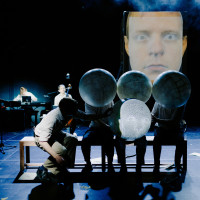
Not everything worked equally well. Several productions still carried an elitist and closed-off character, among them Gefängnis ohne Mauern, Schiff ohne Meer… about Jean Genet, which never fully succeeded in connecting its abstract imagery with the audience. Yet even the less successful works here felt like genuine attempts to explore new forms.
The Ruhr region is currently experimenting intensely. Not everything survives its encounter with the audience. Much disappears again like coal dust. But the best works at these festivals served as reminders of why experimental art still matters: because every now and then, one encounters something that genuinely feels new.
Wittener Tage für Neue Kammermusik, Witten, 24–26 April. Orbit, Festival für Aktuelles Musiktheater, Cologne, 23–26 April
English translation: Andreo Michaelo Mielczarek