Elephants, Dragons, and Deaths: The Operas of Matias Vestergård Live Again
Annonce
For a long time, we measured the vitality of the Danish composing scene by its ability to present the newest of the new. I’ve stood talking to concert programmers who laughed indulgently when I mentioned a young composer by referring to a work that was three or four years old: »That’s an eternity ago«, they said. »He doesn’t write like that anymore – now it’s much better; he thinks so himself too!« And then the look that says: You’re a dinosaur, mate. I actually rather liked that arrogance.
Ugh, how edifying that sounds!
But recently something has shifted. At the genre organization Art Music Denmark, the project »GENSTART« (RESTART] has been launched to help artists get works revived that are no longer brand new. And all around, this return of old acquaintances is flourishing: when the otherwise forward-looking SPOR Festival celebrated its 20th anniversary last year, it did so in part with works by Simon Løffler, Sandra Boss, and Ea Borre that had already been performed at the festival before. Why buy new when you can reuse?
The trend is related to the past decade’s increased focus on sustainability – not only in terms of climate, but also with regard to representation and working life. Artists, too, are entitled to proper conditions, goes the reasoning, and by strengthening efforts toward revivals one seeks to move away from a draining use-and-discard culture and hopes to give works a longer life. Ugh, how edifying that sounds!
Fortunately, it’s more fun than it sounds. One result is that this January it has been possible to re-experience two operas by the flamboyant millennial composer Matias Vestergård in Copenhagen. One, Murder on the Titanic, is a murderous affair from his conservatory days; the other, Lisbon Floor, is another murderous affair – actually even more murderous – which won the Reumert Award for Best Opera in 2023. If you happened to sit on the jury that year, the reunion therefore raised not only the question of what Vestergård can do with music for the stage, but also: Did we get it wrong?
What is it that Vestergård can do with music for the stage? Did we get it wrong?

What a madhouse
We did not. Even though there are, of course, pitfalls in Vestergård’s music drama. As I sit for the second time in my life along the walls of the DKDM Study Stage watching the decadent murder mystery Murder on the Titanic, premiered at the same venue in 2019, it is clear that his greatest strength is also his greatest challenge. How do you create flow in a musical trajectory when you so desperately want constant change – new timbres all the time, new styles, new ways of moving in and out of an aria’s natural development?
A clarinet trundles along à la John Adams’ postminimalism as the ship departs Southampton
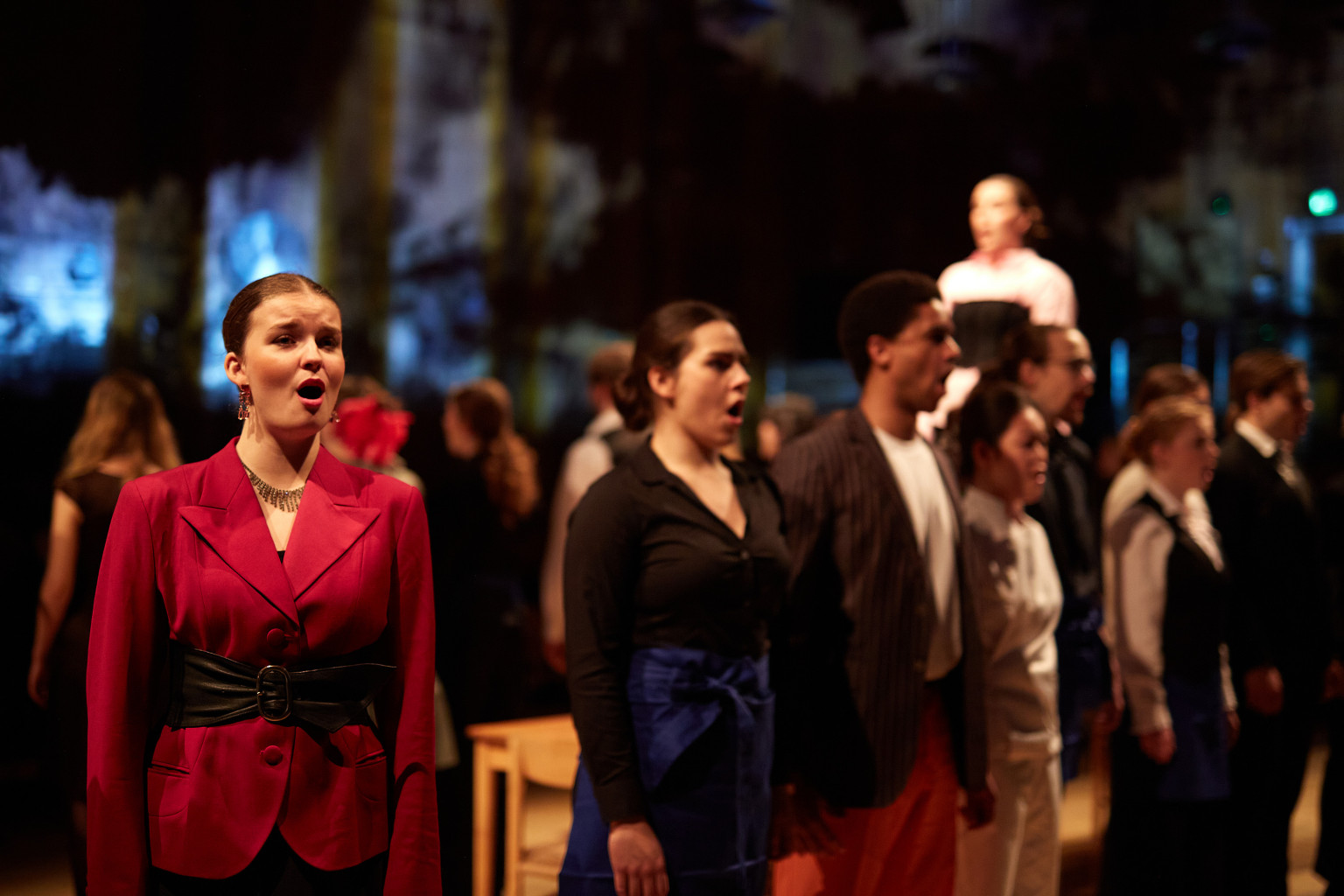
In this early student work, the answer is that, strictly speaking, you don’t. While around twenty characters swarm about the Titanic – poets like Virginia Woolf and T. S. Eliot, the American presidential couple Taft, the cast of Downton Abbey, and a blond youth named Leo – the musical progression is marked by stop-and-go.
A clarinet trundles along à la John Adams’ postminimalism as the ship departs Southampton. Then we approach Latin American rhythms as two waiters note that something doesn’t feel quite right, and a skeleton dance on xylophone develops into capsized sonic blows in the chamber orchestra. Then a jubilant chorus sounds, turning into haunted overtone playing on the violin, while somewhere on the ship the ghost of Edgar Allan Poe lays plans to murder Atticus Finch, the lawyer from Harper Lee’s To Kill a Mockingbird, who is also on board.
And so the opera continues – past vaudeville waltz, shredded brass, hammering on washboard, and an Abrahamic final act sketched in shimmering light-sound after the shipwreck – before it all ends in an opulent Disney chorus and a gallows-humorous injunction to face doomsday with chin held high.
»What a madhouse!« one of the waiters observes along the way. And that may be the key to immersing oneself in Murder on the Titanic. Shortly beforehand, it has been decided to combine Finch’s funeral – yes, Poe did get him – with a 60th anniversary celebration for one of the other passengers, the Italian castrato singer Domenico Mustafà (sung by a mysterious, blasé soprano in a leopard-print suit). It is a madhouse, and before long Mustafà appears in a Lynchian pas de deux with Poe’s ghost, accompanied by a melancholy solo piano somewhere between Chopin and The Godfather.
That’s the Vestergård experience: at some point you accept the absurdity, lean back, and sink into his – and librettist Lea Marie Løppenthins – carefree virtuosity and inventiveness. Their zany yet meticulously executed approach reveals an enormous love for the operatic genre and an equally great disrespect for it. Why shouldn’t everything be possible at once?

Elephants vs. dragons
Now we fast-forward. Three years after the premiere of Murder on the Titanic, Vestergård and Løppenthin were in 2022 upgraded to Takkelloftet at the Opera House during Copenhagen Opera Festival. The composer had only just graduated from the conservatory, but Politiken’s iBYEN editorial team billed him in advance as a “sensation” (the paper’s reviewer was more reserved), and Lisbon Floor unfolded megalomaniacally across three full acts.
Now we’re back in the same place, but for a concert version shortened to one hour, again with Athelas as the house ensemble. Between excerpts from the opera, the plot is summarized over loudspeakers: a group of oddballs move into a haunted high-rise and gradually begin killing one another. In a funny way.
And it is funny. A mezzo-soprano disguised as a nerd is shadowed by tight brass and sings about the balance of power between elephants and dragons. Then she sits down at her Mac, writes a cute-awkward love letter to a guy she later murders in a bloodbath, and with her strangely deep, potato-like timbre she lays herself legato among gongs, gurgling flute, and a bouncing pop minimalism. Shortly thereafter: a wonderful quartet with traces of barbershop, where we learn that the gay couple Alex and Alex’s home-grown baby must be sacrificed to a plant monster. Great.
The only thing one might wish for is that the Opera House one day plucks up the courage to commission a version for full orchestra
As in Murder on the Titanic, there are passages inspired by American composers such as John Adams and Philip Glass: in the opening, a warm melodic sensibility beneath a hectic surface with febrile violins reminiscent of Adams’ narrative drive; toward the end, a deep minor-key loop that sprouts in piano and trombone and then settles into the orchestra as an evil murder mood, as Haagen finishes off countertenor Steffen Jespersen after an argument about – yes, you guessed it – elephants and dragons.
But one also thinks of a composer like George Benjamin, who, like Vestergård, sets declamatory vocals over ever-changing, strange sonorities and, in his partnership with librettist Martin Crimp, seeks to transgress boundaries. It’s just hard to imagine the considerably more serious Brit embedding taped children’s choir and competing with Vestergård–Løppenthin in general high spirits. They have a completely liberated expression of their own.

Too good to be forgotten
What one also notices in Lisbon Floor is a stronger flow than in Murder on the Titanic. The music still goes off the rails, but with more organic transitions. Once again, you can sink into the Vestergård experience and enjoy the constant sonic inventions, but now without the stop-and-go feeling. Everything hangs together, and the only thing one might wish for is that the Opera House one day plucks up the courage to commission a version for full orchestra and dare to pressure-test it on a larger audience.
Perhaps that day is approaching with the increased focus on giving works a longer life. During my Vestergård marathon I run into the director of the experimental opera company OPE-N, Louise Beck, who has just landed from Toronto. There, she and countertenor Morten Grove Frandsen staged Matilde Böcher’s solo opera LOL – Laughing Out Lonely, which since its premiere at SPOR in 2023 has played on several Danish and international stages. This year it continues with trips to, among other places, Edinburgh, Malmö, and New York.
I quite seriously believe there is a need for its unbuttoned yet virtuoso humor in an international operatic landscape
As she herself says, it’s of course easier to tour with a solo opera. But could one imagine Lisbon Floor also gaining an international life? I quite seriously believe there is a need for its unbuttoned yet virtuoso humor in an international operatic landscape that is gasping for new impulses and a less self-important audience. Lisbon Floor is – and this is the whole point of the revival business – far too good to be performed only once, now once and a half. At least if you ask this dinosaur.
»Lisbon Floor«, Takkelloftet, January 15. »Murder on the Titanic«, DKDM, January 20–21. According to plan, Matias Vestergård and Rebekka Bohse Meyer’s interactive opera Family Constellations – also a murder mystery – will premiere in 2027.
English translation: Andreo Michaelo Mielczarek